FableAI: AI Text Adventure RPG
- 4.3
- Rating
- 100.00K
- Installs
- Free
- Price

 Analysis by App-foxy
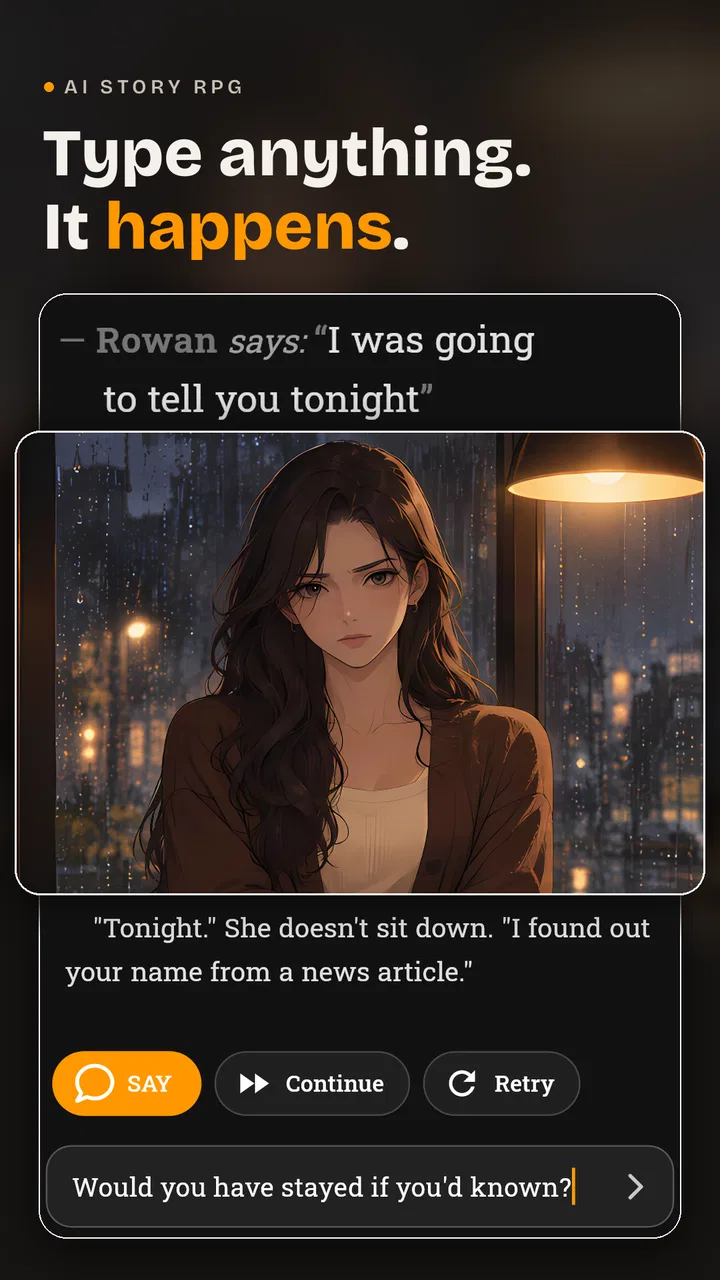
I came away from FableAI - Play Your Story RPG with the feeling that it is less like a conventional adventure game and more like a playable writing session where I get to decide what happens next. That distinction matters. If you want fixed levels, carefully balanced combat, and a clearly authored plot, this may feel loose. If you enjoy imagining possibilities and steering a story through your own choices, the concept has real appeal.
Developed by Vectolab, this free adventure game puts the emphasis on choosing your own direction. Its central attraction is the freedom to shape a personal narrative rather than simply follow a predetermined route. I found that approach most enjoyable when I treated each decision as a prompt for creativity instead of waiting for the game to behave like a traditional role-playing adventure.
The game is available to an Everyone audience, which makes it approachable for younger players and families, although parents may still want to see how the story generation feels in practice. It has reached over one hundred thousand installs and holds a 4.3 average from around four thousand seven hundred ratings, with roughly one thousand one hundred written reviews. Those figures suggest that the idea is connecting with a meaningful audience, while also leaving room for the experience to feel specialized rather than universally appealing.
You May Also Like

 Blood Strike: 2.5 Anniversary
Blood Strike’s Loadouts Turn Every Drop Into a Tactical Gamble
A close look at Blood Strike’s custom loadouts: how fast access to signature weapons reshapes its battle royale rhythm, rewards preparation, and narrows the gap between fights.

 Pandora - Music & Podcasts
Pandora’s Music Is Easy to Start, but Harder to Recover
Pandora’s strength is its low-effort path from a seed to a station. Its weak spot is how much confidence it asks you to place in connection, setup, and quiet recovery.

 8 Ball Pool
 Is Built on Rivalries, Rematches, and Routine
A close look at the rivalries, rematches, shared routines, and unanswered safety questions that turn a quick pool match into a persistent mobile community.

 Samsung Music
’s Quiet Strength Is Playing What You Already Own
Its reach comes less from spectacle than from dependable access to a personal library. That simplicity is both the app’s strongest retention engine and its ceiling.

 AccuWeather: Weather Radar
AccuWeather Review: A Quick, Clear Forecast for Everyday Decisions
For everyday plans, the best forecast is the one you can understand quickly. AccuWeather makes rain timing, radar, and local conditions easy to act on, with a few trade-offs.

 Hill Climb Racing
Why Hill Climb Racing Still Turns Crashes Into One More Run
A tiny car, a bumpy hill and one more upgrade: Hill Climb Racing keeps resurfacing because its simple chaos makes every near-miss feel personal.
More From Our News Desk
View All News


How the story-first adventure works in practice
The first thing I noticed is that the appeal depends heavily on my willingness to participate. In a normal adventure game, the developer has already decided what the world looks like, how characters behave, and which objectives matter. Here, the pleasure comes from testing the boundaries of the story and seeing how my choices influence the direction. I was not simply completing a checklist; I was trying to make the next scene interesting.
That makes the game particularly suitable for short creative sessions. I can open it when I have a few spare minutes, make a decision, and continue the narrative without needing to remember a complicated control scheme or a large collection of game systems. It also works well as a shared activity: one person can suggest an outrageous action, while another decides whether the story should take a sensible or dangerous turn.
The strongest part of the concept is the feeling of ownership. Even when a choice produces an unexpected result, it can still be entertaining because I helped create the situation. A cautious player might guide the story toward exploration and discovery, while a more playful player can deliberately create trouble. The same starting idea can therefore become a different experience depending on the imagination and patience of the person playing.
The real strength is not unlimited freedom by itself, but the invitation to think like a co-author. That mindset makes a noticeable difference. Players who actively describe what they want, build on earlier events, and accept surprises are likely to get more from the game than players who only tap through options while waiting for a conventional reward loop.
Why the open-ended format can be rewarding
I found the open-ended structure useful for experimenting with tone. A scene can be approached as a serious quest, a lighthearted detour, or a strange improvisation. That flexibility is more interesting than it may sound because it gives the player room to discover what kind of storyteller they are. I often preferred making a slightly risky choice over selecting the safest possible response, since unexpected turns created more memorable moments.
Another advantage is replay value through imagination rather than repetition. In a standard adventure, replaying usually means revisiting the same missions with the same objectives. Here, replaying can mean asking a different question, choosing a different attitude, or taking a character in another direction. It is not replay value in the traditional achievement-hunting sense, but it can keep the experience fresh for people who enjoy narrative variation.
There is also a useful social angle. I can imagine friends passing a phone around and treating the game as a collaborative storytelling prompt. One player establishes a goal, another introduces a complication, and a third decides how the protagonist responds. That makes it a better fit for casual group entertainment than many solitary adventure games, especially when everyone enjoys improvising rather than competing for a high score.
A practical tip is to decide on a broad intention before beginning a session. For example, I might aim for a mystery, a rescue mission, or an absurd comedy. Having that small framework gives my choices more consistency and helps prevent the story from becoming a random sequence of unrelated actions. The game is more satisfying when I give it a little direction instead of expecting it to supply all the creativity on its own.
The important trade-off: freedom can feel less polished
The same flexibility that makes the game distinctive can also make it feel less controlled than a carefully scripted role-playing title. A handcrafted adventure usually has deliberate pacing, foreshadowing, and a dependable sense of progression. An open story experience can be more surprising, but it may also produce moments that feel uneven or less dramatically satisfying.
I would not choose this game when I want a tightly designed campaign with a guaranteed payoff. If my priority is strategic combat, character statistics, equipment decisions, or a long sequence of authored quests, a conventional RPG will probably serve me better. The game’s identity is built around imagination and narrative choice, so players looking for mechanical depth may find the experience too light.
There is another subtle limitation: the quality of a session depends on the quality of the player’s input. A person who gives vague directions may receive a less engaging adventure, while someone who adds context and follows through on earlier ideas can create a much more coherent story. That is not necessarily a flaw, but it means the game does not remove the creative work from the player. It shares that work with them.
The presence of in-app purchases, ranging from ninety-nine cents to thirty-two dollars and ninety-nine cents per item, is also worth considering before playing. The game itself is free to start, but anyone who dislikes optional spending should approach the purchase screen carefully and use device-level controls if needed. I would not treat the free entry point as a promise that every part of the experience will be equally cost-free.
Because the current version is 0.18.1, I also approached it as an evolving experience rather than a completely finished, static product. That version label does not tell me how much future development will change the game, but it does reinforce the idea that players should be comfortable with an experience that may continue to develop. People who prefer mature games with years of refinement may be happier elsewhere.
Everyday situations where it makes sense
One realistic use case is a short evening break. I can play for a little while after finishing work, choose a direction for the story, and stop at a natural pause without committing to a full mission. It is less demanding than launching a large console-style RPG, and the creative element gives the session more purpose than simply scrolling through another feed.
It can also work during a family trip or a casual gathering. Instead of asking everyone to agree on a board game with complex rules, one person can begin an adventure and let the group suggest the next move. The Everyone rating makes it easier to consider in mixed-age settings, although the group should still guide the tone if younger children are playing.
For writers, role-playing fans, or anyone who enjoys brainstorming, the game can function as a prompt generator. I would use it to explore character motivations, test an unusual premise, or break out of a creative rut. It should not replace a dedicated writing tool, but it can make the process more playful by turning a blank page into an interactive situation.
A less obvious use is practicing decision-making under uncertainty. Since the result of a bold choice may not be exactly what I expect, I have to adapt rather than insist on a perfect plan. That makes the game enjoyable for players who like improvisation. It is not a formal educational tool, but it naturally rewards flexibility and attention to consequences.
Who should try it, and who should skip it
I would recommend it first to players who enjoy interactive fiction, tabletop role-playing, improvisational storytelling, and adventures where personality matters as much as progress. It is especially promising for people who regularly say they wish games gave them more freedom to invent their own solutions. The free starting price lowers the barrier to testing that idea for yourself.
It is also a good choice for casual players who do not want to memorize elaborate rules. The adventure category can sometimes suggest action-heavy gameplay, but this experience is better approached as a narrative playground. If I want a game that can be played in short sessions and shaped by my mood, it makes more sense than a large, demanding RPG.
I would skip it if I need a fixed storyline with cinematic pacing. Players who judge a game mainly by combat variety, visual spectacle, competitive systems, or detailed progression should look toward a more traditional alternative. The same is true for anyone who becomes frustrated when a story takes an unexpected turn or when their own input has a strong effect on the quality of the session.
Parents considering it for children should remember that an Everyone rating describes the intended age suitability, not the exact experience each player will create. Playing together for the first session is a sensible way to understand the tone and show younger users how to make choices thoughtfully. That shared introduction may also make the game more fun than handing it over as a completely solitary activity.
What to know before installing
The game is free and supports devices running Android 7.0 or later. That makes it accessible on a broad range of Android phones and tablets, although the quality of the experience will still depend on the device and the player’s comfort with the interface. I would check available storage and keep the operating system updated before starting, particularly if the game develops quickly through later releases.
Its store summary presents the experience as a way to choose an adventure and unleash imagination, but I think the more useful interpretation is this: it is a tool for turning decisions into story. That wording helps set the right expectation. I would not install it expecting a conventional quest map; I would install it because I want to see what kind of narrative I can guide into existence.
The purchase range deserves a second practical reminder because free-to-play decisions can affect how comfortably someone uses an app. I would begin without spending anything, learn how the basic experience fits my habits, and only then decide whether optional items add enough value. That approach is especially sensible for families sharing a device or for players who are trying the concept without knowing whether open-ended storytelling suits them.
Compared with a standard adventure game, the trade-off is clear. A traditional title gives me stronger authorial control, more predictable pacing, and often more visible progression. FableAI gives me more room to shape the direction, but asks me to contribute more imagination and tolerate less certainty. Neither approach is automatically better; the right choice depends on whether I want to consume a story or help construct one.
Compared with tabletop role-playing, it offers a more convenient solo or small-group option because I do not need a game master to prepare a setting. The compromise is that a human group can react with richer social nuance and tailor every detail to the players. I see this game as a convenient digital companion to that kind of creativity, not a complete replacement for sitting around a table with friends.
After spending time with it, my verdict is positive but specific. FableAI - Play Your Story RPG is worth trying when the idea of shaping an adventure sounds more exciting than following a finished script. Its best moments come from bold choices, clear personal direction, and a willingness to treat surprises as part of the fun.
I would recommend starting with a simple story goal, making choices that support it, and resisting the urge to abandon an idea after one unexpected turn. That small change in approach can reveal why the game has attracted a growing audience. It is not the right recommendation for every adventure fan, but for imaginative players who want a flexible narrative playground, Vectolab has created a genuinely distinctive free game.
FAQs for FableAI: AI Text Adventure RPG
01What is FableAI - Play Your Story RPG?
FableAI - Play Your Story RPG is an interactive role-playing game that leverages AI to create personalized narratives for each player. Users can make choices that impact the storyline, allowing for a unique experience every time they play. The game combines elements of traditional RPGs with modern AI technology to enhance storytelling.
02Is FableAI - Play Your Story RPG free to play?
FableAI offers a free-to-play model with optional in-app purchases. Players can enjoy the core game without spending money, but there are options to buy additional content, such as exclusive storylines or character customization features, to enhance the gaming experience.
03What devices are compatible with FableAI?
FableAI is available on both Android and iOS platforms. It requires a minimum of Android 8.0 or iOS 12.0 to run smoothly. The game is optimized for both smartphones and tablets, ensuring a seamless experience regardless of the device you choose to use.
04How does the AI in FableAI work?
The AI in FableAI analyzes player choices and adapts the story accordingly, creating a dynamic and personalized gaming experience. It uses advanced algorithms to generate dialogues and plot twists, ensuring that no two playthroughs are exactly the same, keeping the game fresh and engaging.
05Does FableAI require an internet connection to play?
FableAI does require an internet connection for initial downloads and updates. However, once the game is fully downloaded, players can enjoy the story offline. Some features, like community events or online leaderboards, will need an active internet connection to function.
Pros
- Engaging narrative-driven gameplay.
- Beautifully crafted visual design.
- Customizable character options.
- Regular updates with new content.
- Intuitive user interface.
Cons
- Requires constant internet connection.
- In-app purchases can be pricey.
- Limited character voice options.
- Occasional bugs during updates.
- High battery consumption.

FableAI: AI Text Adventure RPG
Gallery